EDU LOPEZ ARCHITECTS
Congress Center Elche
Location: Elche, Spain.
Date: Aug 2025
Typology: Cultural.
Size: 26.680 sqm
Status: International Cmpetition.
Client: The Provincial Council of Alicante
Collaborators: -
Architecture withdraws so that the central space can breathe: a system of volumes that finds its meaning in the void
Elche is a city where architecture has always been built through shadow. Between the urban fabric and the millenary geometry of the Palmeral, space is shaped more by subtraction than by accumulation, more by atmosphere than by object. From this condition emerges the proposal for the Elche Congress Center: not as an autonomous building, but as a continuation of the landscape, an architecture open to climate, light, and time.
The project understands the Palmeral not as a backdrop, but as a conceptual structure. Its logic—based on layers, rhythms, filters, and voids—is translated into an architecture that deliberately avoids iconic gestures, operating instead through spatial depth and environmental order. The building is conceived as an ecosystem of stages, a system of relationships in which form is the result of urban, climatic, and cultural organization.

Exterior view
Rather than occupying the site as a closed object, the proposal releases ground to construct a vegetated public plaza that acts as an interface between city and architecture. This void is not residual, but foundational: a civic threshold where shade, vegetation, and human scale generate a climatic and perceptual transition. The plaza extends the Palmeral into the urban fabric, dissolving the boundary between nature and city, and establishing a new civic center grounded in permanence and everyday use.
Upon this open plane rests a dense yet excavated architecture, a horizontal mass carved by patios, cuts, and voids that introduce light and ventilation in a controlled manner. The project is defined not by the addition of volumes, but by the precision of the void. As in the agricultural landscape that inspires it, architecture is organized around what is allowed to pass through: air, shadow, movement. The building breathes, filters, and regulates, producing a gradual and sensorial spatial experience.

Exterior view
At its core, a clear internal geometry organizes the program: a T-shaped structure that arranges the auditoriums around a shared stage. This decision transforms functional efficiency into a spatial principle, enabling multiple configurations without compromising the coherence of the whole. The architecture thus becomes inherently adaptable—capable of accommodating different scales and uses—while remaining grounded in order and formal economy.

View of the lobby

Circulation is conceived as an interior topography, a continuous system of ramps, stairs, and platforms that wrap around the main volumes and construct a dynamic experience of the building. Far from secondary elements, these paths become public architecture: spaces of encounter, pause, and perception. Movement becomes part of the narrative, and the building reveals itself through displacement.
View of the cafe
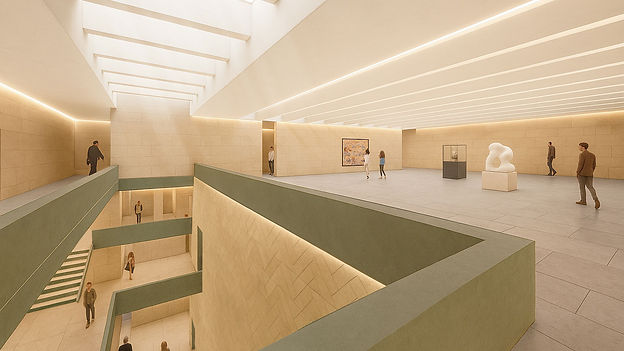
View of the exhibition hall
Light, as in the Palmeral, is never direct. It is filtered, reflected, and fragmented. Skylights, double skins, and vertical voids produce a calibrated illumination in which shadow becomes architectural matter. The resulting atmosphere avoids spectacle in favor of luminous calm, reinforcing the character of the place. Here, shadow does not conceal; it defines.
Materiality follows this same logic of belonging and abstraction. A clear duality is established between the heavy and the light, the opaque and the permeable, evoking the relationship between trunk and canopy. The bases and enclosed volumes are built with high thermal-mass materials, earthy tones, and mineral textures, anchoring the building to ground and climate. In contrast, circulation structures and filtering elements adopt lighter metallic materials in muted green hues, engaging with vegetation and shifting light.

Main auditorium

Conference room
The result is an architecture that does not seek to dominate, but to belong. A building that operates simultaneously as cultural infrastructure and constructed landscape—capable of organizing its surroundings, activating public space, and projecting Elche’s identity forward. The Congress Center is conceived as an architecture of continuity: between city and nature, event and everyday life, memory and transformation.

Multifunctional Room

Multifunctional Room