EDU LOPEZ ARCHITECTS
MUSEUM OF CONTEMPORARY ART
Location: Panamá City, Panamá.
Date: Feb 2026
Typology: Cultural.
Size: 10.500 sqm
Status: International Competition.
Client: MAC Panamá
Collaborators: -
A system of shifting volumes where space is not contained.
The project for the new headquarters of the Museum of Contemporary Art of Panama is conceived as an architecture deeply rooted in its cultural and urban context, understanding the building not as an isolated object, but as an active extension of the place and its dynamics. The proposal is driven by a clear intention: to create a museum that not only houses art, but becomes itself a contemporary expression of Panamanian identity, capable of integrating culture, city, and experience into a single spatial system.
The concept is based on a reinterpretation of Panamanian molas, understood not merely as an aesthetic reference, but as a generative system. These textile pieces, constructed through layered compositions, define a spatial logic that is translated into the project through the aggregation of volumes that attach, shift, and stack. Each of these layers introduces variations in scale, depth, and program, creating a composition where solid and void are in constant dialogue. Color, intrinsic to the molas, is incorporated as a tool for reading the project, allowing the different elements to be identified while reinforcing their cultural character without resorting to arbitrary formal gestures.

Exterior view
This reference is complemented by the direct influence of the Boca La Caja neighborhood, whose urban structure—based on the superposition of elements and incremental growth—becomes an organizational model. The project abstracts this logic to construct a precise architecture that retains this condition of assembly, where each volume integrates into a larger system without losing its identity. Fishing nets, a characteristic element of the local context, are reinterpreted as a façade pattern, reinforcing the relationship between the building and its surroundings while embedding a cultural dimension tied to the place.

Exterior view
The design process begins from an existing condition: the fully excavated site. On this base, a new platform is constructed, organizing the building across different levels of relationship with the city. The lower level is conceived as an extension of the urban fabric, where the commercial area is located, configured as a system of open streets that continue the logic of the city. This layer is separated from the museum through a difference in levels, allowing flows to be differentiated and preventing interference between uses, while acting as an activating element of the whole

View of the lobby
The main access to the museum occurs at street level, on a platform conceived as an extension of public space. This plane is not understood merely as an entrance, but as a place of transition and permanence that extends the city into the building. The café and museum shop are placed on this level as independent volumes, capable of operating autonomously and activating the public space at different times of the day, reinforcing the urban character of the project.

View of the lobby
The plan is organized around a central atrium, attached to the system of exhibition spaces, with both elements separated by the circulation core. This arrangement creates an intermediate buffer zone that acts as both an acoustic and spatial filter, preventing direct noise transmission and allowing a gradual transition between public space and the exhibition areas. The atrium not only organizes the building but becomes its main relational space, structuring movement and articulating the whole.
In section, the atrium develops as a continuous void that visually and spatially connects all levels of the building. Through a system of concatenated voids, multiple cross-relationships between levels are established, allowing visitors to maintain a constant global perception of space. This system avoids fragmentation and creates a dynamic experience, where floors are not perceived as isolated levels, but as parts of a continuous spatial field.
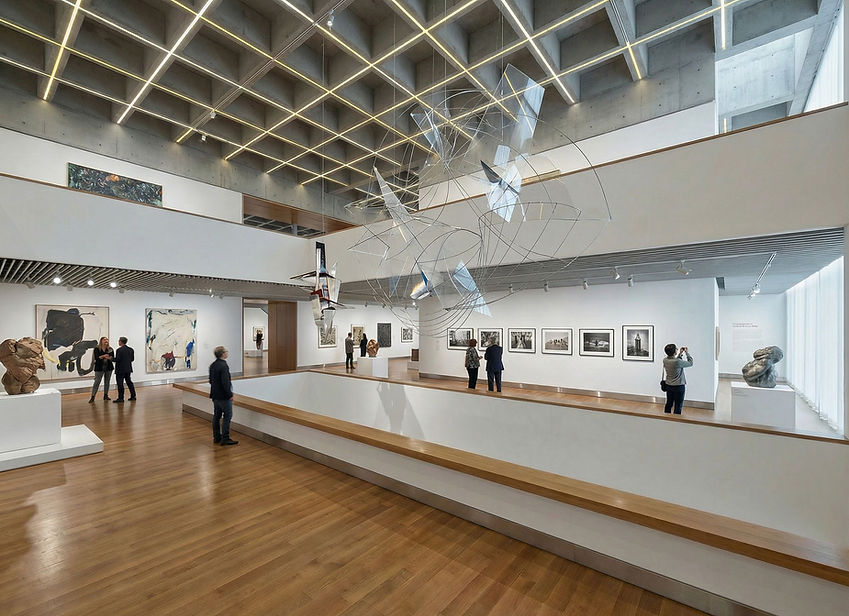
Main Exhibition hall
Main Exhibition hall
The exhibition spaces are conceived as an open and connected system, moving away from the traditional model of closed, monothematic galleries. The project proposes a continuous exhibition experience, where spaces relate to one another through visual connections, voids, and intersecting paths. This configuration allows for the incorporation of large-scale works, particularly sculptural pieces, which can be perceived from multiple viewpoints and levels, enriching the visitor experience and generating greater spatial complexity.
The aim is to move beyond a linear and closed circulation logic, proposing instead a system in which visitors can explore the museum freely, constructing their own experience through constant visual and spatial relationships. Voids act as connective elements that allow anticipation, discovery, and reinterpretation of spaces, creating a richer, more open, and contemporary experience.

Comercial exterior view
At the urban scale, the building is conceived as a permeable and accessible piece, capable of integrating into the everyday life of the city. Exterior spaces, platforms, and circulation paths are not limited to serving the museum, but are configured as collective spaces where cultural activity blends with urban life. The project does not establish a rigid boundary between building and city, but rather proposes a gradual transition in which public space flows into the architecture, and the architecture opens itself to the city through terraces distributed across different façades and levels, generating a continuity that extends the museum beyond its own limits.